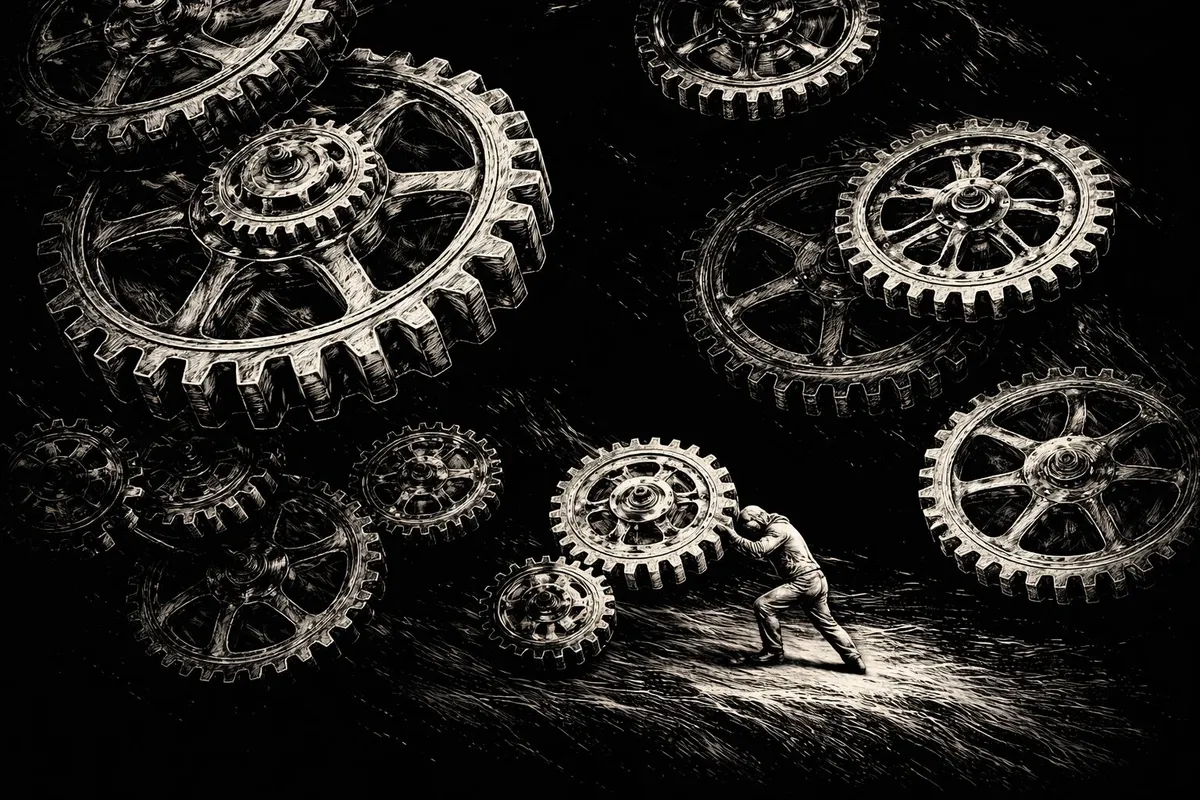
Machines learned how to be human.
Humans forgot how to think.
In 1976, 40% of American high school seniors read six or more books for pleasure. In 2024, 40% haven’t read a single one all year. This isn’t a dip in a metric. It’s a crack in the foundation of civilization.
I’m not trying to scare you. I’m trying to make you see.
The Cognitive Bedrock Is Crumbling
Ivy League professors are noticing something: their students can’t finish the books that used to be standard reading.
Not because they can’t understand them. Because they can’t sustain attention long enough.
Reading a 400-page book isn’t entertainment. It’s the only way to build complex models inside your head. When you follow a long argument across chapters, you’re training yourself to track multiple threads, tolerate ambiguity, and delay gratification.
These abilities are disappearing.
Scores aren’t declining. The cognitive bedrock of civilization is eroding. When 40% of young people don’t touch a book for an entire year, they’re not losing a “reading habit.” They’re losing the hardware that runs complex thought.
Frictionless Is a Disaster
AI promised a world where learning doesn’t hurt.
That’s a neuroscience nightmare.
Students are using three different AIs to write their essays, then a fourth AI to sprinkle in “typos” so it looks human-written. They’re not being lazy — they’re precisely bypassing the most valuable part of thinking.
Focus. Connecting ideas. Logical reasoning. These aren’t “soft skills.” They’re physical neural wiring. Every time you force yourself to link two seemingly unrelated concepts, your synapses grow. Every time you let AI do it for you, that circuit never forms.
Friction is the food your mind grows on.
Without it, the developmental muscles of your brain simply atrophy. This isn’t a metaphor. It’s biology.
The Industrial Contract Is Bankrupt
Education used to come with an implicit deal:
Train yourself into a precise execution machine → get a stable job and a decent life.
That was the “industrial contract.” It worked for over a century.
Now the machines are better at it than you.
Generative AI can write reports, run analyses, code software, translate languages. On every dimension that can be standardized, it already outperforms most trained humans. If the endpoint of education is “get a job,” the system is bankrupt. The factory model that built this contract never cared about your soul — only your compliance.
We’re entering what I call the Foggier Future. Nobody can predict which jobs exist in five years. In that world, your only shelter isn’t a certificate — it’s the depth of your life experience and your flexible competence.
Education must shift from knowledge transfer to capability awakening. Not teaching you what to do, but waking up who you can become.
The Passenger Trap
The straight-A student might be the most dangerous person in the classroom.
They look like they’re engaged. Homework on time, test scores high, never disruptive. But if you look closely, their eyes are empty.
This is “passenger mode” — body in the seat, soul already gone.
Some 4.0 GPA students are so bored by the material they’re silently shopping online under their desks. Their high marks aren’t proof of deep exploration. They’re sophisticated compliance. The system flags them as success stories, but they never actually showed up.
AI makes coasting almost costless. When you can generate a passable essay in ten minutes with ChatGPT, the price of passenger mode drops to zero.
Compliance is masking intellectual dropout. This is the most invisible crisis.
Find Your Spark
A student named Kia got obsessed with the JFK assassination.
She didn’t write a standard history paper. She designed an escape room — weaving clues, evidence, and timelines into an immersive puzzle experience. To build it, she voluntarily dove into physics (ballistics), programming (interactive logic), and writing (narrative structure).
Nobody made her.
That’s the Spark — the thing that makes your eyes light up. Once you find it, boring subjects transform into raw material for your mission. You stop being a passenger. You become an explorer with direction.
The Spark is the awakening of inner will. It makes you voluntarily push through tedious but necessary practice, because you know it leads to the thing you actually care about.
This is what machines can never simulate. AI can write your essay. It can never make you want to write it. That inner will — the self-directed drive — is also the hardest thing for parents to cultivate without destroying it.
Introducing Beneficial Friction
If frictionless is a disaster, the fix is deliberately creating friction.
Step one: Build screen-free oases. Physically block the temptation. Use a dumb phone. Not because your willpower is weak — because these technologies are engineered against your neural vulnerabilities. Admitting that isn’t weakness. It’s honesty.
Step two: Sketch before you search. Before asking AI anything, force yourself to draw the logic on paper first. Even if it’s ugly, even if it has holes — the act of drawing is your neural wiring growing.
Step three: Train attention like a muscle. Start with ten minutes of focused reading. No phone, no tab-switching. Add time each week. Focus isn’t a gift. It’s a trainable biological capacity.
The core principle: you must learn to think independently before you’ve earned the right to edit AI’s answers. The order cannot be reversed.
”Understanding” Won’t Save You
The most common mistake: believing that teaching kids “AI literacy” solves the problem.
Think about Oreos.
You know they’re unhealthy. High sugar, high fat, zero nutrition. But when they’re in front of you — you eat them anyway. Knowledge doesn’t defeat design that targets your nervous system. Oreos are engineered to be irresistible.
AI products use the exact same playbook. Infinite scroll, instant feedback, zero friction to access — they’re precision-targeting your dopamine circuits. Telling a child “use AI responsibly” is as effective as telling an adult “eat Oreos responsibly.” The effect is near zero.
Literacy alone can’t save a person whose willpower has been dismantled by engineered temptation. What we need is structural guardrails — physical barriers, usage rules, environmental design. Not because we distrust individuals, but because the opponent is too powerful.
The Human Premium Playbook
In a world drowning in synthetic content, what can’t be replaced?
Oracy. When you stand in front of people and express a complex idea — spontaneously, logically, with conviction — you’re proving with your entire body that “a real, non-synthetic soul is speaking.” AI can write a flawless article. It can’t replace you standing there, delivering belief through your voice and eyes.
Deep attention. The ability to think about one problem for two straight hours without drifting — in 2026, that’s an extremely rare capacity. It’s the prerequisite for all higher-order cognition. Without it, you can’t research, can’t write at length, can’t solve genuinely complex problems.
Meaning-making. Reflecting on why you’re alive. Connecting fragmented experiences into a directional narrative. This is uniquely human — AI can summarize your life, but it can never decide what your life means.
These three things are your identity card in the age of synthesis.
Redefining What It Means to Be Human
John Dewey said it a hundred years ago:
Education isn’t about getting a job. It’s about creating a democratic society.
In the AI era, that statement matters more than ever.
We don’t educate children to beat AI. Nobody beats AI — on the dimensions it’s built for.
We educate children so that in a world saturated with AI, they still clearly know who they are.
Thinking should hurt. Learning should have resistance. Growth should have friction.
These aren’t bugs. They’re the source code of being human.
Protect it.