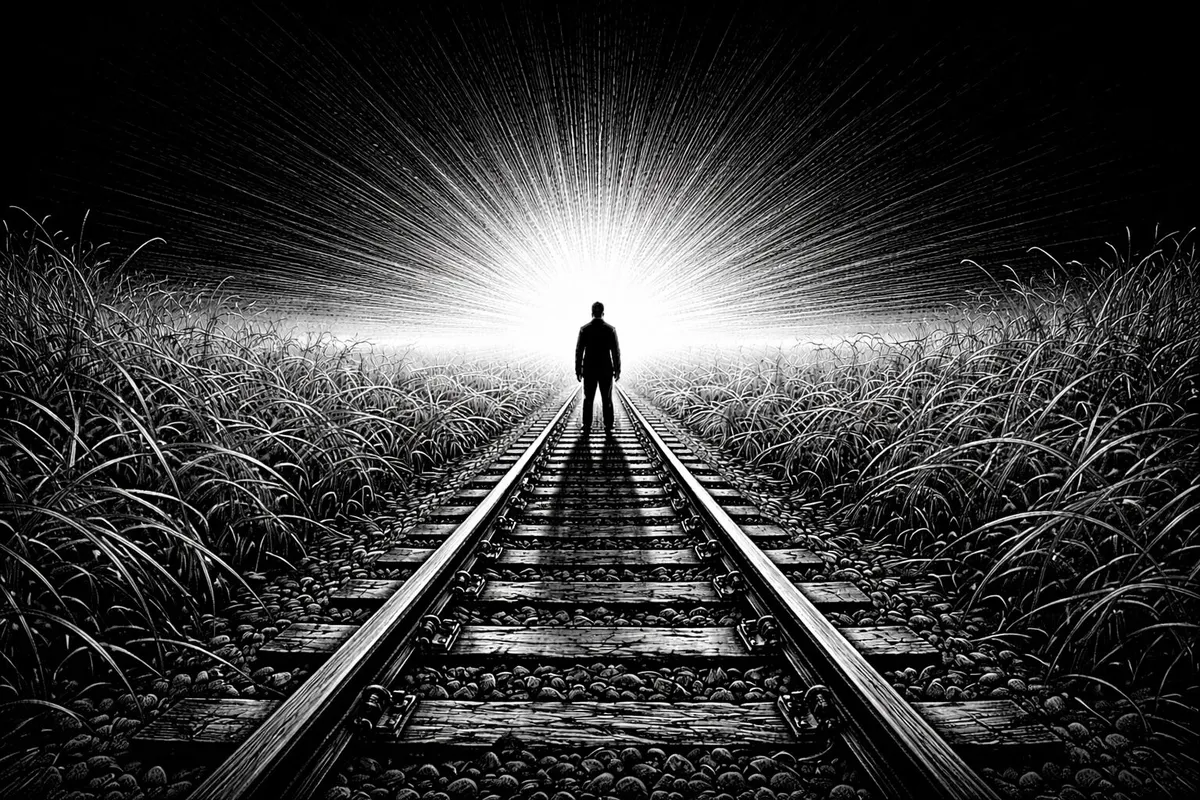
You think you’re worried about your child’s future.
You’re not. You’re worried about yourself — because you refuse to admit the world you built your life on is already dead.
Three years ago I started studying how different countries educate their children. Finland, Singapore, Israel, India, Thailand. I thought I’d find the optimal system. A template I could copy-paste onto my own family.
I was wrong.
I didn’t find answers. I found a mirror. And the mirror didn’t reflect my child’s problems. It reflected the barrenness of my own thinking.
Your experience is your child’s biggest obstacle
The previous generation had a clear path: good grades, good university, good job, good retirement. That path had one hidden assumption — the world is stable.
The world hasn’t been stable for a long time.
Technology iterates faster than any education system can keep up with. You’re trying to use your twenty-year-old experience to train a person who will live in 2050. That’s not love. That’s navigating with a map of roads that no longer exist. The hardest part? Learning to let go is the entire point of parenting.
Here’s the harder truth: you can’t even find the right words to talk to your child anymore. Not because you’re not smart enough. Because the map in your hands shows streets that were demolished years ago.
The first thing we need to do is not sign our kids up for more classes.
It’s admitting we’re lost.
Anything that promises speed is not education
The biggest scam of this era is packaging “training” as “education.”
Three days to master public speaking. Seven days to learn programming. Twenty-one days to build a habit. That’s training. Training solves skill problems. It’s fast, measurable, and has standard answers.
Education is none of those things.
Education is brutally slow. It’s the friction and osmosis between one life and another. In a world racing toward frictionless everything, that slowness is a feature, not a bug. It’s about how a person understands their connection to the world. And that connection often hides in the details adults overlook — the veins of a fallen leaf, the smell of rain, the silence after a stumble.
You don’t have patience for those details. So you chose the shortcut.
The shortcut gives you peace of mind. It has never given your child real growth.
Finland tore down the grading fence
In a Finnish forest class, the teacher doesn’t ask “What’s the Latin name for this tree?”
The teacher asks: “What do you think rain tastes like?”
No standard answer. No exam. No ranking.
When learning stops being about someone else’s scorecard, something remarkable happens — competition loses its anchor. Children stop studying to beat the kid next to them. They start studying to understand the world.
Imagination is ten thousand times more valuable than standard answers. Because standard answers solve known problems. And everything your child will face in the future is unknown.
Singapore wrote fear into its DNA
But don’t romanticize Finland.
Fly to Singapore and you’ll see the opposite. Five-year-olds drilling worksheets. An entire society gripped by a feeling called Kiasu — the fear of losing.
Think that’s insane?
It’s not. It’s rational. When you understand Singapore’s history — a tiny island with no natural resources, abandoned, threatened, forced into independence — you understand the sentence etched into every Singaporean’s bones: Nobody owes you survival.
Education is never created in a vacuum. It’s rooted in a nation’s trauma, fear, and survival instinct.
Talking about education without talking about history is like talking about seeds without talking about soil. Pointless.
Israel’s relationship with failure shook me the most.
There, a failed startup isn’t called a failure. It’s called experience. A person who’s gone bankrupt three times gets more trust from investors the fourth time — because they’ve already made every mistake worth making.
German precision and manufacturing excellence aren’t innate gifts either. They’re the result of obsessive error correction. Behind every component accurate to the millimeter are countless rounds of trial and failure.
And in New Zealand, a school principal lets six-year-olds climb three-meter-tall trees.
Why? Because he understands a counterintuitive truth: only by giving children control over their own safety do they actually learn to protect themselves.
Our approach to education is the exact opposite. We eliminate every risk for our children, then wonder why they’re so fragile. The survival algorithm built into every brain needs real difficulty to activate.
Changing countries doesn’t change your mind
Plenty of parents can’t take the pressure. They flee to Thailand, to Bali, thinking a new environment will fix everything.
Then they discover they just switched to a more expensive track.
I met a Chinese father who’d ordained as a monk in Thailand. He said something I still can’t forget: “Eastern people are attached to success. Western people are attached to freedom. Attachment itself makes no distinction.”
If your mind hasn’t truly awakened, a change in geography is just escape. You bring the same anxiety, the same need for control, the same scorecard from Beijing to Chiang Mai.
Environment cannot save a mind that refuses to update.
The person who needs to change isn’t your child — it’s you
France has institutions called Maisons Vertes — “Green Houses” — for children aged zero to three. The staff treat infants as complete human beings. They speak to them, ask for their consent, explain what’s about to happen.
Beautiful. But we also need to accept a less beautiful fact: children are human, and humans aren’t all good.
Children feel jealousy. They lie. They can be cruel. Assuming children are inherently pure will leave you shattered when you encounter bullying and betrayal.
Education isn’t loving a projection of your fantasy. Education is loving a real person — whether they’re being good or bad right now.
In India, a class is considered incomplete if no student challenges the teacher. Their “Toy King” builds science equipment from trash — not just as a lesson in physics, but as a defiant refusal to let scarcity win.
The classroom doesn’t require an actual forest. The classroom requires connection — to the ground beneath your feet, to the reality around you. In the high-rises of Shanghai or the farmland of Sichuan, if you understand the texture of your environment, that’s your classroom.
Be a clear-eyed gardener
So what do you actually do?
You don’t need to fly to Finland. You don’t need to emigrate to New Zealand. You don’t even need to change your child’s school.
You need to update your own operating system.
The essence of parenting isn’t what classes you sign your child up for. It’s what you believe, what you practice, and what you transmit in your silence.
The essence of education isn’t institutional design. It’s the connection between one human heart and another.
Look. Listen. Take one small action in the ordinary moments of today. Don’t wait for a perfect plan. Perfect plans don’t exist. The only thing that exists is the one tiny change you can make right now.
Observing other countries is how you see the limits of your own.
Seeing how others exist is how you rediscover your own possibility as a free individual.
Everyone deserves to be raised again. Not by someone else. By themselves.
Learning was never about grades. Learning is about being more alive.
And being alive has no standard answer.